Noise Phobia in Dogs - Signs, Symptoms, Diagnosis & Treatment

About Noise PhobiaPage 1 of 13

Noise Phobia is a reaction to a noise that is so intense and out of context that it limits the dog’s normal functioning, it is “all or nothing” (it typically results in a disproportionate response to the stimulus), and it persists long after the threat is gone. These dogs often anticipate events and show an increased sensitivity to low-level sounds that they fear.

How many dogs have a noise phobia?

  • Up to 50% of dogs may be afflicted with a noise phobia.
  • However, only about 13% of US dog owners report that their dogs suffer from fear of noises.1

How do pet owners handle noise phobia?

  • Pet owners first go online to research solutions.
    • 84% of pet owners search online for their dog’s behavior problem.2
  • 3 out of 4 pet owners say that they will talk to their veterinarians about behavior issues.2

Make sure you have the right answers to help address their concerns. You will learn the answers to help address their concerns today.

Questions to ask pet owners

More importantly, here are some very basic questions to ask owners to determine if their dog might be suffering from a noise phobia:

  1. What does your dog do when it hears a loud noise such as thunder, fireworks, gun shots, vacuum cleaners, loud voices or car/truck engines?
  2. How has your dog’s reaction to noises changed over time?
  3. During a noise event, is it possible to get your dogs attention, such as getting him to play?
1 October 2014, GFK Fear of Noises Product Market Assessment Opportunities, prepared for Ceva Animal Health
2 July 2014, Burke Brand Equity Report, prepared for Ceva Animal Health

About Noise PhobiaPage 2 of 13

Cause and Effect

How do noise phobias occur?

A fear response to a loud noise is actually a sensible protective mechanism – that noise could potentially harm the dog – but our dogs need to learn that certain noises are not a problem and they will not be harmed by the noise.

  • A key factor for the most common noise phobias – thunderstorms, fireworks and gunshots – is that the sounds occur in bouts or series of loud noises, separated by periods of quiet.3
  • Sensitization for most dogs may result over time from the cumulative effect of repeated exposure to the stimulus and resulting repeated minor stress responses.
  • Fears and phobias associated with noise are not uncommon in dogs and can be seen as early as 9 weeks old.
  • Noise sensitivity will always worsen over time if intervention strategies are not implemented by the veterinarian and the pet owner.

What systems can be affected by noise phobia?

  • Central Nervous System
  • Gastrointestinal
  • Urinary
  • Musculoskeletal
  • Respiratory
  • Skin
3 Sherman and Mills 2008

About Noise PhobiaPage 3 of 13

Common Characteristics

What are the noise phobia incidence/prevalence rates?

  • Up to 50% of dogs may be afflicted with a noise phobia. However, only 16%2 of owners reported that they would actually seek advice for treatment for their dog from their veterinarian; this means that for every 3 cases seen in practice 17 cases may go unmentioned.
  • The most common noise phobias (listed in descending order) are: 1. fireworks, 2. thunderstorms, 3. vacuum cleaners, 4. loud voices, 5. engines, 6. door bangs, 7. party poppers and 8. bird scarers.
    • However, the first four account for >65% of cases.4

What is the average patient signalment?

  • Breed – Working group dogs, specifically herding group breeds and hounds.
  • Age – Typically doesn’t develop at less than 1 year of age. Dogs of all ages can be afflicted with noise phobias.
    • However, 78% of the cases presented in one study, were between 1 and 5 years.
    • Dogs that have not previously been exposed to noise at a young age, but that may have future exposure to noise may be at higher risk.
  • Sex – No sex predilection.

Are there any genetic or breed commonalities?

  • All breeds are susceptible to developing noise phobias. However, there appears to be a higher incidence among the working dog group, specifically herding breeds and hounds. It is suspected that there is a genetic component to this disease.
  • Dogs adopted from animal shelters also appear to have an increased risk of developing noise phobias.
2 July 2014, Burke Brand Equity Report, prepared for Ceva Animal Health
4 Sheppard G, Mills DS. Evaluation of dog appeasing pheromone (DAP) as a potential treatment for dogs fearful of fireworks. Veterinary Record, 2003; 152, 432-436

About Noise PhobiaPage 4 of 13

Signs & Symptoms

What are the most common signs and symptoms of noise phobia in dogs?

  • The behavioral manifestations of noise phobias vary from the inhibited responses of whining, panting and salivating to the more reactive responses of running and escaping.
  • In some cases, those responding in a reactive manner may injure both themselves and their environment in their frantic attempt to escape. It is this population of dogs that are most likely to be referred for assistance.
  • However, any and all dogs displaying any type of distress response need to receive intervention. Management needs to start at the earliest reported signs as it may require less interventional strategies, leading to greater compliance and more successful management of the dog’s fear leading to a better quality of life.
  • Clinical signs
    • Hiding/withdrawing, trembling, panting, cowering, hypersalivation, inappropriate urination and/or defecation, vomiting, excessive vocalization, self-trauma, fleeing, hyper-vigilance, seeking human attention, destructiveness, abject panic.
  • Physical exam findings
    • No significant findings unless the dog has injured itself in some manner.

What are the main causes of noise phobia in dogs?

  • Sudden traumatic event associated with noise.
  • Long term repeated exposure to noise with repeated stress responses.
  • Social transmission, where one dog learns or copies another dog’s fear.
  • Sometimes the triggering event is never identified.

DiagnosisPage 5 of 13

The diagnosis of a noise phobia is straightforward, as usually the fear-eliciting sound is loud and distinct. The owner can usually identify when the noise occurs and can identify the animal’s specific response.

Differential diagnosis

  • Gastrointestinal disease – colitis, parasites, dietary sensitivity or other causes for diarrhea or urgency to defecate, seizures
  • Urinary – cystitis, other causes of lower urinary tract disease, diabetes or other causes of increased urine volume, seizures
  • Neurologic – seizures, hepatic encephalopathy

CBC/Biochemistry/Urinalysis

  • No significant findings

Imaging

  • Imaging: No significant findings

Other diagnostic testing, pathologic findings

  • No further testing usually warranted

TreatmentPage 6 of 13

The prognosis varies greatly and depends on the individual, the duration of the phobia, the ability to control the stimulus during treatment and the success of finding an effective controllable stimulus for desensitization and counter-conditioning.

What treatments may be utilized?

  • All dogs with noise phobias should have a treatment plan that incorporates the use of ADAPTIL® pheromones and the building of a den or a ‘safe spot’ where they can escape from the auditory stimuli as much as possible, as recommended by the British Small Animal Veterinary Association. We’ll teach you how to build a den later on in this CE.
  • Dogs with a more severe disease should also have either short and/or long term medication, depending on their needs, added to their treatment protocol.
ADAPTIL® is a registered trademark of Ceva Santé Animale S.A.

TreatmentPage 7 of 13

Pheromones

What are pheromones?

  • Pheromones are a chemical substance secreted by an animal and deposited into the environment by an animal as a communication signal that can affect the behavior or physiology of others of its species or itself.

How are pheromones detected?

  • The vomeronasal organ (VNO), also called the Jacobson’s Organ, is responsible for the detection of pheromones.
  • The opening to this organ is called the incisive papilla and is located just behind the dog’s incisors in the roof of the mouth. The pheromone enters the VNO, triggers nerve receptors which allows the nerves to conduct nerve impulses directly to the brain of the dog resulting in a behavior change.

Where do pheromones work?

  • Pheromones affect the amygdala which is responsible for emotional learning and the fear response.
  • Once the pheromone detecting nerves are triggered, impulses are sent to this area of the dog’s brain – helping to reduce the behavioral responses to fear.

How safe are pheromones?

  • Pheromones never enter the systemic circulation and there are no known adverse effects of using them.
  • They may also be safely combined with any additional management strategies, including medication, needed to help your noise phobic patient.

How effective are pheromones?

Pheromone products are clinically proven to help reduce the behavioral responses to fear associated with noise phobia.

For example, in a study of 30 dogs who showed fear of fireworks (all dogs experienced at least 4 firework events) – dogs that were exposed to a pheromone product such as ADAPTIL® showed significant improvements in the owners’ rating of 9 of the 14 behavioral signs of fear that were examined and a decrease in media frequency of 13 of the 14 signs of fear.4
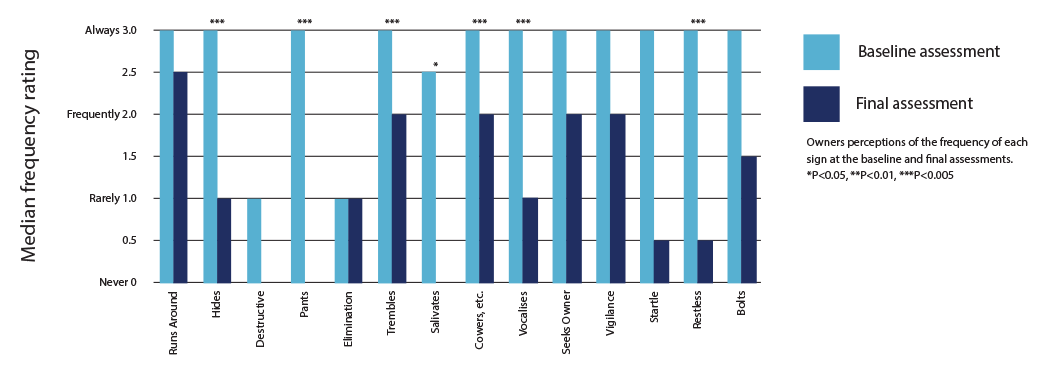
In addition, 22 of 30 owners reported a significant lower overall fear rating.

4Sheppard G, Mills DS. Evaluation of dog appeasing pheromone (DAP) as a potential treatment for dogs fearful of fireworks. Veterinary Record, 2003; 152, 432-436
ADAPTIL® is a registered trademark of Ceva Santé Animale S.A.

TreatmentPage 8 of 13

Pheromones

Which pheromones do we use to help manage noise phobias?

  • Products such as ADAPTIL® (made by Ceva Animal Health) contain a synthetic version of the dog appeasing pheromone that the bitch produces from her intermammary region shortly after whelping and until her puppies are weaned.
  • This pheromone provides a calming, reassuring and nurturing effect that is able to be detected by dogs during their entire lifespan, resulting in a lifelong consistent and predictable response.

Collars

  • This is a good option for most dogs that have noise phobias.
  • While some noise events are very predictable, others like thunderstorms are not. A collar allows the dog to benefit from the calming capabilities of  pheromones any time a noise may occur.
  • Use a collar during thunderstorms or firework season.
  • Should be applied 1 week prior to events if possible. A minimum of 48 hrs. prior to expected event for best results.
  • The collar should be fit snugly around the dog’s neck as it is heat activated. Most collars will not be effective if they or the dog are wet. Once both are dry, collars will resume diffusing pheromones.

Diffusers

  • Diffusers are great for households with more than one dog or a dog that is strictly indoors.
  • Pheromone diffusers should be placed where the dog spends the most time and where you build a ‘safe spot’ or den for the dog to hide during noise events.
  • Diffusers should be plugged in 1 week prior or a minimum of 48 hrs. prior to an expected event. Use for a full 30 days for best results.
  • Diffusers should be placed in a location where the release of the pheromone is not obstructed by furniture or other objects.

Sprays

  • Pheromones also come in spray format and can be sprayed onto a bandana or ThunderShirt® before and during the storm or noise event.
  • Sprays may have a moderately strong alcohol smell which can be unpleasant to some dogs. While this does dissipate extremely fast, any object to be sprayed should be sprayed away from the dog to prevent a negative reaction. Wait for 15 minutes before exposing object to dog.
ThunderShirt® is a registered trademark of ThunderShirts, LLC.
ADAPTIL® is a registered trademark of Ceva Santé Animale S.A.

TreatmentPage 9 of 13

Building a ‘safe spot’ or den

All dogs that have a noise fear or phobia need a place to hide. It is a required component of noise phobia management.

Instructions for pet owners:

  • Identify a place where the dog usually hides or a place in the home that is dark, quiet and away from disturbing activity.
  • Reinforce this area by:
    • Keeping windows and curtains closed
    • Turning off lights
    • Providing extra bedding and blankets for your dog to burrow under to add additional comfort
    • Supplementing the den with pheromone products
      • Spray the bedding, blankets and towels with pheromone spray
      • Use a pheromone diffuser in the room
      • Use a pheromone collar

TreatmentPage 10 of 13

Drugs

While there are currently no approved drugs for the management of noise phobias, veterinary behaviorists frequently recommend the following medications for dogs with noise phobias. Before prescribing, veterinarians should review Plumb’s Therapeutics Brief for complete information on the following drug’s side effects, contraindications and drug interactions. DO NOT use acepromazine- it can increase reactivity to sound and may be particularly inappropriate for anxiety induced by sounds.
Short term or event associated medications

  • Best if given on an as needed basis – potent for panic-type responses, although the duration of the effect may only be a couple hours but it may last longer depending on the pet.
  • Ideally given 1 hour prior to event.
  • Drugs can be used to alter a dog’s emotional response and memory of the frightening event which can make the dog more manageable and help prevent the problem from getting worse.
  • Benzodiazepines
    • Provides anxiolytic effects but relatively less sedation.
    • Alprazolam 0.02-0.05 mg/kg orally 2-4 times daily as needed, should be given 1 hour prior to event.
    • Practitioners should have owners give a trial dose to determine response prior to use during a noise event.
    • Some dogs experience a paradoxical response including causing excitement or exacerbating aggressive behaviors.
  • Serotonin antagonist/reuptake inhibitor
    • Provides anxiolytic effects and relatively more sedation than alprazolam.
    • Trazodone 3-5 mg/kg orally prior to the event but may used twice daily to start, may increase to 3 times daily if needed. May also increase dose, if needed.
    • May cause sedation.

Long term medication

  • Long term medication can be useful adjunct treatment to behavioral therapy, when used appropriately and for a sufficient duration.
  • These medications may take 4-8 weeks to become effective.
  • These medications may be more important when the dog has other co-morbid fears or other behavioral related problems associated with noise phobia.
  • Also if thunderstorms or other noises occur more frequently and/or less predictably in the dog’s environment and/or the owners are gone a lot when the noises may occur.
  • Selective serotonin reuptake inhibitor
    • Fluoxetine 1-2 mg/kg orally once daily. Base starting dose on
      individual patient history and severity of clinical signs.
    • May cause decrease in appetite.
  • Tricyclic antidepressant
    • Clomipramine 1–2 mg/kg PO twice daily initially and eventually
      up to 3 mg/kg PO once to twice daily.
    • May cause decrease in appetite, irritability.

Combining long term and short term medication

  • Short term medication may be combined with long term medication to increase anxiolytic effects, if the patient requires it for management.

Additional Advice to Give to Pet OwnersPage 11 of 13

In addition to use of pheromones, building a ‘safe spot’ or den and possibly the use of medication to deal with noise phobia in dogs, here’s some additional advice for your pet owners:

Advice for actions to take during an episode

  • Pet owners should ignore fearful behaviors and try to act as normal as possible.
  • Most pet owners want to make their dog feel better and pay extra attention to them when they are frightened. Changes in the owner’s behavior can become a cue for the dog that predicts “something bad is getting ready to happen!”.
  • Pet owners can provide distractions during noise events such as playing games, providing chew toys, etc.

Take preemptive measures

  • Talk to new pet owners about preventing sound fears and phobias by exposing puppies to a variety of mild sounds and stimuli while they are young. Always provide puppies with positive reinforcement in the form of special treats when they experience new and potentially frightening things.
    • Include different types of noises, lights, handling and movement.
    • Habituation during early development will help prevent many fears and phobias.
    • Puppies, especially those adopted from a shelter, should also be fitted with a pheromone collar as soon as they are adopted.

Desensitization therapy

  • Audio based programs can be effective for long-term treatment of noise phobias.
  • Before starting therapy, it is important to ensure that the dog is healthy and has no cognitive impairment.
  • Behavioral therapy should only be carried out when the chance of exposure to noises is small.
  • It typically takes around 6 weeks to begin to see an improvement and should therefore be started well ahead of anticipated noise events such as thunderstorms and fireworks. For firework and thunderstorm phobias behavioral therapy is best introduced in the fall, but may vary region to region.
  • In all cases desensitization should be followed by counter-conditioning in order to consolidate behavioral improvement.
  • Note that a poorly managed or inappropriate therapy may make the problem worse. Encourage pet owners to adhere to the recommended plan.

SummaryPage 12 of 13

As we have learned, noise phobia is a reaction to a noise that is so intense and out of context that it interferes with the dog’s normal functioning, it is “all or nothing” (it typically results in a disproportionate response to the stimulus), and it often persists after the threat is gone.

The stats

  • Noise phobias affect a significant portion of the veterinary patient population, up to 50% of dogs seen. However, most patients are not diagnosed.
  • Only 16% of pet owners seek advice from their veterinarian. Many pet owners don’t consider reporting behavior problems until it impacts their property or quality of life.
  • Veterinary professionals should proactively probe for behavior issues – specifically noise phobias. Remember, only 3 out of every 20 cases are diagnosed and receive intervention and treatment.

Ask questions

  • Certain types of dogs such as herding dogs, hounds and dogs adopted from animal shelters are at a higher risk of developing noise phobias, but any dog is at risk. Questioning owners, in particular owners of dogs at high risk, is the key to opening the door to diagnosis and treatment.
  • Two starting questions are:
    • How does your dog react to loud noises?
    • Has your dog’s reactions to loud noises changed over time?
  • All dogs with an abnormal response to a noise require treatment, as without treatment virtually all of these dog’s clinical signs progress in severity over time.

The treatment options

As recommended by the BSAVA, all noise phobic patients require at least two points of intervention to start:

  • Use pheromones (ADAPTIL®) – which is clinically proven to help reduce fearful reactions to loud noises.
  • Teach your clients how to build a ‘safe spot’ or den.

Depending on the severity of the dog’s clinical signs a third treatment component may need to be added, that being short and/or long term medication.

Increase your clientele

With increased vigilance and screening, several outcomes become possible.

  • Veterinarians have the ability to treat a largely under-diagnosed patient population.
  • Earlier intervention is implemented which may lead to better outcomes with less treatment modalities.
  • More dogs receive the treatment they need decreasing their suffering.
  • The pet and owner will have an improved quality of life.
ADAPTIL® is a registered trademark of Ceva Santé Animale S.A.

QuizPage 13 of 13

Congratulations

You have finished reviewing “Noise Phobia in Dogs – Signs, Symptoms, Diagnosis & Treatment” presented by Ceva. If you are ready to take the corresponding quiz click the button below. If you would like more time to review the content feel free to go back and peruse the course content at your leisure.

Bibliographies
1 Sherman and Mills 2 Blackwell 2005
1.) Sheppard G, Mills DS. Evaluation of dog appeasing pheromone (DAP) as a potential treatment for dogs fearful of fireworks. Veterinary Record, 2003; 152, 432-436
2.) October 20014, GFK Fear of Noises Product Market Assessment Opportunities, prepared for Ceva Animal Health July 2014, Burke Brand Equity Report, prepared for Ceva Animal Health